
'We have to be prepared for the larger disruption that is likely to take place.'

MSIL, which currently has a subscription service that allows customers to lease its petrol-run and strong hybrid vehicles on a flexible, long-term basis without ownership commitments, will introduce a leasing service as well.

The auto major is not just looking at domestic sales, but also planning to ramp up exports to key markets from here, like the Middle East, North Africa and Australia.

'Currently, EVs are about 30-50 per cent more expensive than ICE vehicles. I believe the inflection point for EVs will come when this price gap narrows to 20-25 per cent. That's when people will start coming in.'
Currently there are 26 licensed players in the P2P lending sector but only 10-11 are actively operating.

'The path beyond diesel is not going to be clear. It is really going to be dependent on applications.'

About 99,165 electric cars were sold in India in 2024, but electric car penetration -- share of electric car sales in total sales -- was just about 2.5 per cent.

Chinese electric carmaker BYD is focusing on launching vehicles in the Rs 25-45 lakh price range in India even as it continues to evaluate customer preferences and demand in more affordable segments, its Head of Electric Passenger Vehicles in India Rajeev Chauhan told Business Standard.

However, while Splendor's annual sales surged 31.7 per cent to 3.638 million units between 2019 and 2024, Hero's other models suffered sharp drops.
Tata Motors is the leader in the electric car market with about 62 per cent share.

However, the company has not provided a timeline for the launch of the small electric car.
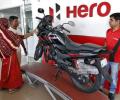
Hero MotoCorp anticipates a big rebound in two-wheeler (2W) sales in rural India over the next four to eight quarters, driven by favourable factors such as a decent monsoon, rising crop prices, improved employment conditions, and increasing consumer confidence, its chief executive officer (CEO) Niranjan Gupta said on Wednesday. Amid tepid rural sales, he stated that there is a "strong case" for GST (goods and services tax) on entry-level two-wheelers, which are under 125 CC, to be moved down from 28 per cent to 18 per cent as they are used by "masses".

Fintech firm BharatPe is targeting an initial public offering (IPO) in the next 18-24 months with the company expecting profitability at an earnings before interest, taxes, depreciation and ammotisation (Ebitda) level for FY25, chief executive officer (CEO) Nalin Negi said.

'Without his vision and foresight, his willingness to take a risk that no one else was willing to take, his deep and abiding love for India, the Indian automobile industry could not have become the powerhouse that it has become.'

From highways connecting once-remote regions to aviation networks carrying millions, India's infrastructure story is one of transformation.

Widespread use of crypto assets, including stablecoins, can have a negative impact on the macroeconomic and financial stability of a country, the Reserve Bank of India (RBI) said on Monday. In its Financial Stability Report (FSR), the banking regulator highlighted that excessive use of crypto assets can reduce effectiveness of monetary policy, worsen fiscal risks, circumvent capital flow management measures, divert resources available for financing the real economy and threaten global financial stability.

In 2024, the National Payments Corporation of India (NPCI) approved 20 third-party Unified Payments Interface (UPI) applications, a record since UPI's launch in 2016. This surge reflects growing interest from financial technology (fintech) companies, driven by the integration of credit products like UPI-linked credit cards and pre-approved credit lines.

The average value of retail digital payments dropped 48 per cent from Rs 8,769 in March 2021 to Rs 4,560 in March 2024 due to a growing preference to use digital modes of transactions for small value payments, according to the Reserve Bank of India's (RBI) report on the trend and progress of banking in India.

The majority of crypto investors in the country have invested in mainstream virtual digital assets (VDAs) such as Bitcoins, altcoins like Dogecoin, Shiba Inu, and Ethereum, followed by non-fungible tokens (NFTs) and stablecoins, a compilation of year-end reports of crypto majors CoinDCX and CoinSwitch revealed. The crypto exchange platform CoinDCX reported that 14.6 per cent of total investments on its platform were allocated to Bitcoin, while CoinSwitch saw the share of the VDA at 7 per cent.

IndiGo on Wednesday said it was exploring an earlier introduction of wide-body planes in its fleet to meet the growing demand for international travel. Industry sources said the airline was in talks with Norse Atlantic Airways to wet-lease six B787 planes in its fleet.
 © 2026 Rediff.com - Investor Information - Advertise with us - Disclaimer - Privacy Policy - Sitemap - Feedback - About us - Terms of use - Grievances